
Dense Brush Reduced to Usable Mulch
Hydro-Ax Mulching for Overgrown Properties and Dense Brush
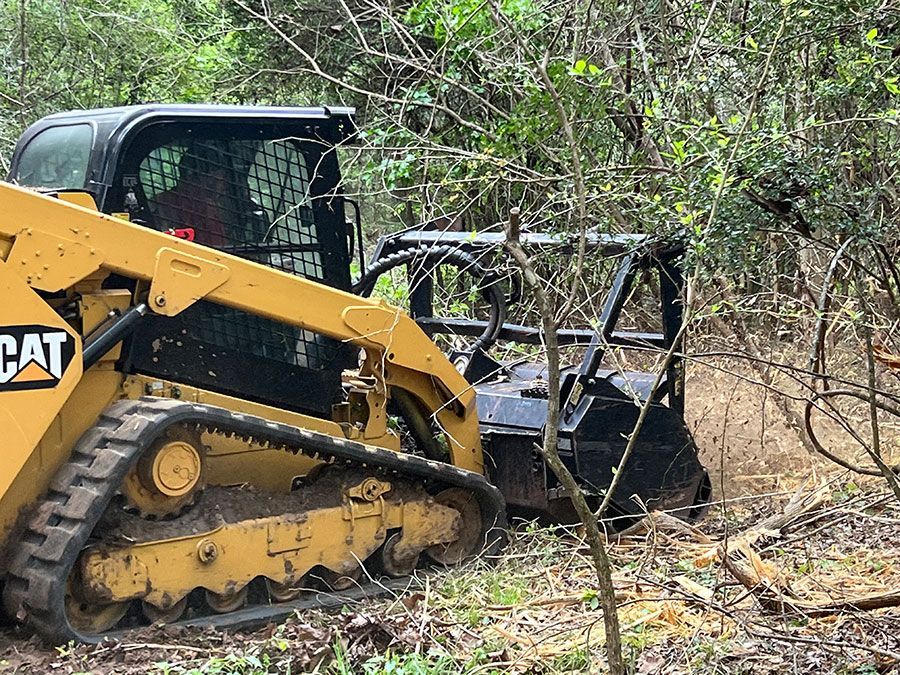
Big Dog Land Clearing operates a Caterpillar 275XE equipped with a Denis Cimaf mulcher attachment, processing dense brush and trees into chips without leaving debris piles behind. Our powerful Hydro-Ax equipment is designed to tackle a wide variety of vegetation, from dense underbrush and thick scrub to cedar, oak, and other hardwood trees. By efficiently mulching trees and brush directly on-site, we eliminate the need for extensive debris removal and costly hauling, providing a cleaner, faster, and more cost-effective land clearing solution. After the mulcher passes through, what remains is a layer of uniform chips distributed across the ground—no burn piles, no waiting for debris removal, and no secondary cleanup phase.
The Denis Cimaf attachment processes standing brush, fallen timber, and small trees into two-to-four-inch chips on contact, converting what would otherwise require multiple equipment passes and hauling into a single-step operation.
What Happens After Hydro Ax Mulching Completes
The mulcher reduces vertical growth to ground level, leaving behind a layer of organic material that settles into the soil rather than forming erosion channels or bare patches. This matters during heavy rain events common to the region—the chip layer absorbs water and slows runoff, preventing the gullying that follows blade work on sloped terrain.
You notice clear sight lines across previously impassable areas, accessible pathways where tangled brush once blocked movement, and a stable surface that supports foot traffic and light equipment without the mud holes left by tracked dozers. The mulch layer continues breaking down over the following months, adding organic matter back into the soil.
Questions About Hydro Ax Mulching Work
Property owners preparing land for development, fence installation, or wildlife management often ask how the mulching process differs from traditional clearing and what the finished surface looks like.
What size material can the Denis Cimaf mulcher handle?
The attachment processes brush, vines, and trees up to moderate diameter in a single pass, reducing them to chips without requiring separate cutting or stacking—the mulcher head contacts standing vegetation and grinds it down to the soil line.
When should mulching be scheduled before survey or construction work?
Clearing before surveyor arrival allows accurate boundary marking without having to return later to remove growth that blocks sight lines, and the settled mulch surface provides stable ground for stakes and equipment access within days of completion.
What happens to the mulch after it's spread across the property?
The chips break down over several months, adding organic material to the soil and forming a protective layer that reduces erosion.
How much area can be processed in a typical workday?
Depending on vegetation and density, 1-2 acres can be mulched in a typical workday.
Big Dog Land Clearing operates across Montgomery County, Harris County, and the surrounding communities with equipment designed for the mixed hardwood and brush conditions typical of Southeast & East Central Texas. Request an estimate based on your property's current vegetation and intended use after clearing.